
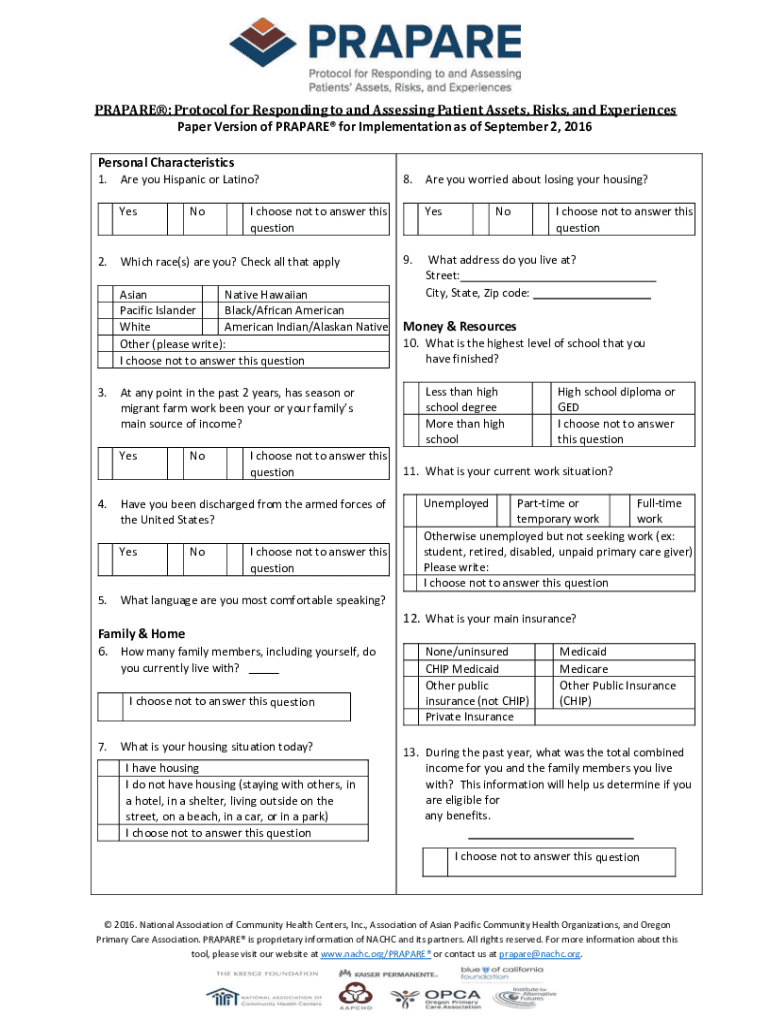







Definition and Meaning of the PRAPARE Patient Assessment Form
The PRAPARE Patient Assessment Form stands for the Protocol for Responding to and Assessing Patient Assets, Risks, and Experiences. It is a standardized tool used to evaluate social determinants of health (SDOH) for patients within the healthcare setting. This assessment aids healthcare providers in identifying non-medical factors that may influence a patient's health outcomes, such as housing stability, education, and access to healthcare services. By using this form, practitioners can tailor interventions to address specific social and economic challenges faced by their patients.
Steps to Complete the PRAPARE Patient Assessment Form
- Preparation: Ensure all necessary patient information is available before starting the form. This includes basic demographic data, medical history, and any prior assessments.
- Patient Interview: Conduct a comprehensive interview with the patient to gather detailed responses to the questions on the form. Encourage honest and open communication.
- Document Responses: Carefully fill out the form, documenting each response clearly and accurately. Utilize the fields provided for text responses, checkboxes, and dropdown menus as applicable.
- Review for Accuracy: Once completed, review the form for accuracy and completeness. Ensure no questions are left unanswered unless they are inapplicable.
- Follow-up Plan: Develop an individualized care plan based on the insights gained from the assessment. Address any identified social determinants that could impact health outcomes.
Key Elements of the PRAPARE Patient Assessment Form
- Personal Characteristics: These sections capture basic demographic information, including age, ethnicity, and language preference, to understanding cultural contexts in patient care.
- Living Situation: Questions about current housing conditions help ascertain housing stability and identify potential needs for social services.
- Employment and Income: Evaluates the patient’s employment status and income level, crucial for understanding economic pressures that may affect health and access to care.
- Social and Emotional Health: Addresses issues such as stress, social isolation, and emotional well-being, which are vital for creating comprehensive care plans.
- Access to Care: Includes inquiries on healthcare accessibility, such as insurance coverage and transportation, aiding in identifying potential barriers to receiving medical services.
How to Obtain the PRAPARE Patient Assessment Form
The form can be accessed through several channels:
- Healthcare Providers: Many clinics and healthcare facilities provide the PRAPARE form to patients as part of their standard intake or follow-up procedures.
- Online Resources: The form is available for download from official healthcare and social work organization websites, facilitating easy access for practitioners and facilities.
- Training Sessions: Participation in workshops or training sessions focused on social determinants of health often includes access to the PRAPARE form as part of the educational materials provided.
Who Typically Uses the PRAPARE Patient Assessment Form
The PRAPARE form is primarily used by:
- Healthcare Providers: Doctors, nurses, and social workers utilize the form in clinical settings to better understand and address the social factors affecting their patients' health.
- Community Health Centers: These centers often employ the form to optimize care for underserved populations, leveraging the data to connect patients with community resources.
- Public Health Organizations: These entities use the form to gather data for research and to inform policy decisions regarding health disparities and resource allocation.


Outlining the Legal Use of the PRAPARE Patient Assessment Form
- Confidentiality and Privacy: The form must be used in compliance with HIPAA regulations, ensuring patient data confidentiality and privacy are maintained at all times.
- Consent Requirements: Patients should provide informed consent before the form is administered, understanding how their information will be used and shared.
- Documentation and Record Keeping: Accurate record-keeping with correct documentation of the form’s findings is essential for legal and medical integrity.
Software Compatibility for the PRAPARE Patient Assessment Form
The form is compatible with a variety of document management and electronic health record (EHR) systems:
- EHR Systems: Many healthcare facilities integrate PRAPARE into their EHR platforms, allowing seamless access and updating as part of the patient's digital health records.
- Document Management Software: Platforms like DocHub support the PRAPARE form by providing tools to fill, sign, and secure the document, ensuring data integrity and ease of use.
- Cloud Storage Integration: The platform allows users to save completed forms within cloud services such as Google Drive for easy access and sharing among healthcare teams.
Important Terms Related to the PRAPARE Patient Assessment Form
- Social Determinants of Health (SDOH): Conditions in the environments where people are born, live, work, and age that affect a wide range of health risks and outcomes.
- Risk Factors: Elements of a patient's environment or behavior that may increase the likelihood of negative health outcomes.
- Intervention Strategies: Approaches developed to address identified risks and leverage patient assets, aiming to improve overall health and wellness.
Examples of Using the PRAPARE Patient Assessment Form
Consider the following real-world applications:
- Case Scenario - Housing Insecurity: A patient identified as experiencing housing instability can be connected with local housing support services to secure more stable living conditions, which in turn improves their health outcomes.
- Case Scenario - Employment Assistance: For patients facing unemployment, a completed form can lead to referrals for job training programs or employment support services that enhance their economic stability.
These examples highlight how the form is used to translate the assessment of social determinants into actionable, supportive interventions for patients.